
How many times has Paris Saint Germain won the Champions League?
Unlike historic powerhouses such as Manchester United or Real Madrid, Paris Saint-Germain does not possess a century-long legacy built on European triumphs. Yet the club has rapidly grown into one of the most formidable forces in modern European football.
Founded in 1970, PSG entered a new era after being acquired by Qatar Sports Investments in 2011. Backed by strong financial power, the Parisian side began recruiting some of the world’s biggest stars, transforming the club into a dominant presence in Ligue 1 for more than a decade.
Domestic success, however, has never been the ultimate objective in Paris. The club’s ambition has always been to conquer Europe, particularly the prestigious UEFA Champions League. Many of the superstars brought to the Parc des Princes arrived with a single mission: to deliver the long-awaited continental crown.
That ambition inevitably leads to a key question for fans and observers alike: how many times has Paris Saint Germain won the Champions League? In this article, Soccer24.net takes a closer look at the club’s European journey to provide the answer.
How many times has Paris Saint Germain won the Champions League?
The 2024-25 campaign marked a historic milestone for Paris Saint-Germain, as the club secured its first ever UEFA Champions League title. It represented the high point of PSG’s modern era and finally fulfilled the ambition that had driven the club for more than a decade.
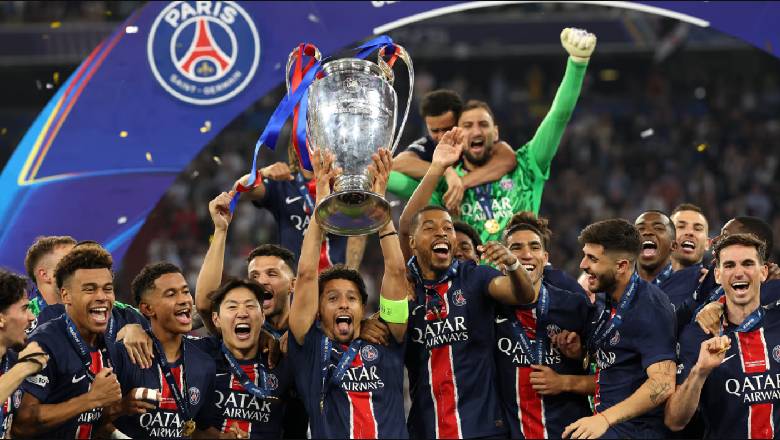
The road to the trophy was far from straightforward. Under the new league phase format, PSG endured an inconsistent start and finished 15th in the standings with four wins, one draw and three defeats. Despite the shaky beginning, the Parisian side gradually found momentum once the knockout rounds began.
Their Round of 16 tie against Liverpool F.C. proved to be one of the toughest challenges. After the two legs ended 1-1 on aggregate, PSG held their nerve to advance through a 4-1 penalty shootout victory. Confidence continued to grow in the semi-finals, where they overcame Arsenal F.C. with a convincing 3-1 aggregate win.
The final delivered the most emphatic moment of the campaign. Facing Inter Milan at Allianz Arena in Munich, PSG produced a stunning performance and claimed a 5-0 victory to lift the trophy.
Much of the success was credited to manager Luis Enrique. Moving away from the era defined by global superstars such as Kylian Mbappé, Enrique shaped a balanced squad built on tactical discipline, collective pressing and the energy of young players.
For many years, Paris Saint-Germain were often accused of lacking the so-called “European DNA.” Long before lifting the UEFA Champions League trophy in 2025, the club’s pursuit of continental glory had been marked by a series of painful setbacks and costly disappointments.
One of the most traumatic moments came in the 2016-17 Round of 16 against FC Barcelona. PSG appeared certain to progress after a commanding 4-0 victory in the first leg. However, the return match at Camp Nou turned into one of the most dramatic comebacks in football history. Barcelona won 6-1, completing what became widely known as “La Remontada.” The defeat left a deep psychological scar and created a lingering sense of fragility whenever the French side held a significant advantage.
The closest PSG came to European glory before 2025 arrived in the 2019-20 campaign. Under the guidance of Thomas Tuchel, a squad led by stars such as Neymar and Kylian Mbappé reached the Champions League final for the first time in the club’s history. Their opponent, however, was a formidable Bayern Munich side that had dominated the tournament. The German champions, who had famously defeated FC Barcelona 8-2 earlier in the competition, secured a narrow 1-0 victory in the final. The decisive goal came from Kingsley Coman, a Paris-born winger who had developed in PSG’s own academy, making the defeat even more painful for the French champions.
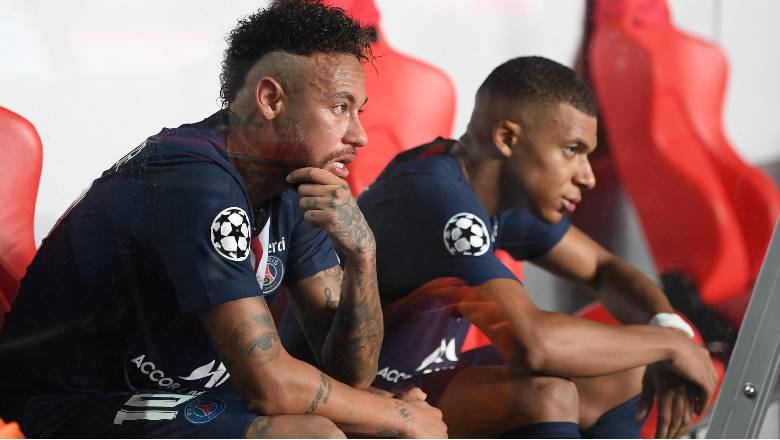
In 2021, PSG attempted to strengthen their bid for European success by signing Lionel Messi. The Argentine legend joined Neymar and Mbappé to form the much-talked-about attacking trio nicknamed “MNM.” Despite the star power, PSG again suffered a dramatic exit. In the 2021-22 Round of 16 against Real Madrid, the Parisian side held a 2-0 aggregate lead with around 30 minutes remaining. The tie turned abruptly when Karim Benzema scored a rapid hat-trick, eliminating PSG and reinforcing doubts about the club’s mentality in decisive European moments.
Ultimately, PSG’s long-awaited triumph in 2025 was not simply a fortunate breakthrough but the result of a gradual transformation. Under the leadership of Luis Enrique, the club moved away from the era defined by glamour and individual superstars. Instead, the focus shifted toward building a younger and more disciplined collective. Emerging talents such as Warren Zaïre-Emery and new additions like Désiré Doué symbolized a new direction, one built on commitment to the team and the badge rather than individual status.
PSG’s results in the UEFA Champions League over the past 10 years
2015-16 - Quarter-finals
2016-17 - Round of 16
2017-18 - Round of 16
2018-19 - Round of 16
2019-20 - Runner-up (Final)
2020-21 - Semi-finals
2021-22 - Round of 16
2022-23 - Round of 16
2023-24 - Semi-finals
2024-25 - Champion
Soccer24h.net has answered the question: How many times has Paris Saint Germain won the Champions League?
Stay ahead of the game with updated football results, accurate odds, and daily predictions on our platform.
The Most Popular
-
 How many games are in a League 1 season? The 5 most successful clubs in league history
 -
 Missing World Cup 2026: Why is Italy so bad at football recently?
 -
 What is Argentina's biggest win in football history? When Argentina produced a stunning two-digit victory
 -
 Who scored the most goals against Liverpool? The former Manchester United star leads the way
 -
 Real Madrid all time XI: The greatest Galácticos ever assembled
 -
 What position does Bellingham play for Real Madrid? Key facts about England’s superstar
 -
 Who is the coach of France national football team? Interesting facts you should know
 -
 Top 5 greatest moments in World Cup history: The night Lionel Messi finally claimed his crown
 -
 How much did Real Madrid buy James Rodriguez? Top 5 interesting facts of Colombian midfielder
 -
 How much did Real Madrid pay for Luka Modric? Some fun facts about the Croatian midfielder