
Top 5 biggest stadiums in South Africa: Home of the 2010 World Cup opening match ranks No.1
The 2010 FIFA World Cup remains one of the most memorable editions in the tournament’s history, defined by its electric atmosphere, emotional moments, and impressive venues. As the first World Cup held on African soil, South Africa delivered a well-organized event, backed by significant investment in infrastructure, particularly its stadiums.
In this article, Soccer24.net highlights the top 5 biggest stadiums in South Africa, highlighting how the tournament reshaped the nation’s sporting infrastructure.
Top 5 biggest stadiums in South Africa
5. Cape Town Stadium - 58,300 capacity
Cape Town Stadium, stands as one of South Africa’s most recognizable sporting venues. Set between Table Mountain and the Atlantic coastline, it became a focal point of the 2010 FIFA World Cup.
Construction began on March 26, 2007, and the stadium was completed in December 2009 after a 33-month build, with costs estimated at around $600 million at the time. It went on to host eight matches during the tournament, including high-profile fixtures such as Spain vs Portugal 2010 World Cup Round of 16, Argentina vs Germany 2010 World Cup Quarter-final, and the semi-final between Uruguay vs Netherlands 2010 World Cup Semi-final.
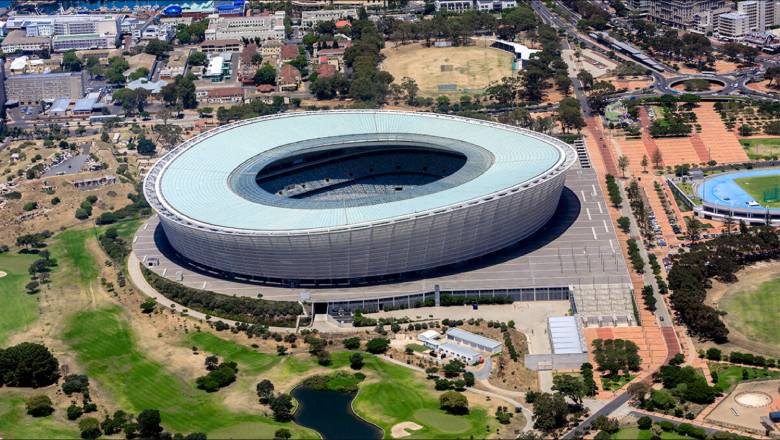
Beyond football, the stadium has continued to play a major role in international sport. It was the venue for the 2022 Rugby World Cup Sevens, marking the first time the event was staged on African soil.
4. Mmabatho Stadium - 60,000 capacity
Located in Mahikeng, the capital of South Africa’s North West Province, Mmabatho Stadium was completed in 1981 and quickly gained attention for its unconventional design. Its layout, often likened to a “geometric explosion” or even a game of Tetris, has made it one of the most unusual and visually distinctive stadiums in world sport.
Despite its striking appearance, the venue was not selected for use during the 2010 FIFA World Cup, as it did not meet FIFA’s requirements in areas such as sightlines, safety standards, and media facilities. Today, the stadium serves a more local role, regularly hosting training sessions for clubs and provincial athletics events.
3. Odi Stadium - 60,000 capacity
Odi Stadium, situated in Mabopane to the north of Pretoria, is often regarded as the “sister” venue to Mmabatho Stadium. Completed in the early 1980s, the stadium was developed under the Bophuthatswana administration led by Lucas Mangope, as part of a broader effort to showcase large-scale infrastructure and project the image of a functioning independent state during the apartheid era.
Over time, however, the venue fell into serious decline and is now frequently described as a “ghost stadium,” reflecting years of neglect and underuse. It was officially decommissioned in 2005 after failing to meet structural safety standards and regulatory requirements under the Safety at Sports and Recreational Events Act.
2. Ellis Park Stadium - 62,567 capacity
Ellis Park Stadium, located in Doornfontein, Johannesburg, has long been regarded as the spiritual home of South African rugby while also holding a significant place in international football. The venue is best remembered for staging the final of the 1995 Rugby World Cup.
Originally opened in 1928, the stadium was rebuilt in 1982 and later upgraded again in 2009 to meet FIFA requirements for the 2010 FIFA World Cup. The renovation, valued at around R500 million at the time, ensured it remained a key venue, hosting seven matches during the tournament, including the quarter-final between Spain vs Paraguay 2010 World Cup Quarter-final. It had also previously staged the final of the 2009 FIFA Confederations Cup Final.
Ellis Park is widely known for its steep stands and intense atmosphere, creating a daunting environment for visiting teams. However, its history also includes tragedy. On April 11, 2001, a match between Kaizer Chiefs and Orlando Pirates ended in disaster when overcrowding led to a fatal stampede that claimed 43 lives. The incident prompted major reforms in stadium safety across the country.
1. FNB Stadium - 94,736 capacity
FNB Stadium stands as the largest stadium in South Africa and across the African continent, widely regarded as a symbol of the region’s football culture. More than just a sporting arena, it has become a landmark tied closely to the nation’s modern history.
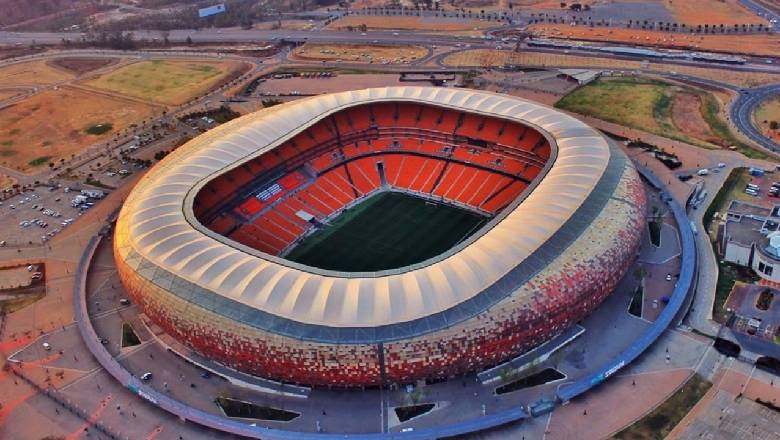
The stadium was first constructed between 1986 and 1989 at a cost of around R67 million, serving as a central venue for football during a pivotal period as the country moved away from apartheid. Ahead of the 2010 FIFA World Cup, it underwent a near-complete reconstruction between 2007 and 2009, with investment reaching approximately R3.3 billion, equivalent to about $440 million at the time.
Its distinctive exterior, inspired by a traditional African calabash pot set over a fire, has made it one of the most recognizable stadium designs in the world. The venue is home to Kaizer Chiefs FC and regularly hosts major events beyond football, including rugby matches, concerts, and large political gatherings.
FNB Stadium has also been the stage for defining national moments. In 1990, Nelson Mandela delivered his first major speech here after being released from prison. Two decades later, it hosted the opening match of the World Cup, where South Africa national football team drew 1-1 with Mexico national football team, highlighted by Siphiwe Tshabalala’s memorable opening goal.
Top 5 biggest stadiums in South Africa
5. Cape Town Stadium - 58,300 capacity
4. Mmabatho Stadium - 60,000 capacity
3. Odi Stadium - 60,000 capacity
2. Ellis Park Stadium - 62,567 capacity
1. FNB Stadium - 94,736 capacity
Soccer24.net has listed Top 5 biggest stadiums in South Africa
Follow us for comprehensive football coverage, including live results, updated odds, and expert match predictions.
The Most Popular
-
 How many games are in a League 1 season? The 5 most successful clubs in league history
 -
 Missing World Cup 2026: Why is Italy so bad at football recently?
 -
 What is Argentina's biggest win in football history? When Argentina produced a stunning two-digit victory
 -
 Who scored the most goals against Liverpool? The former Manchester United star leads the way
 -
 Real Madrid all time XI: The greatest Galácticos ever assembled
 -
 What position does Bellingham play for Real Madrid? Key facts about England’s superstar
 -
 Who is the coach of France national football team? Interesting facts you should know
 -
 Top 5 greatest moments in World Cup history: The night Lionel Messi finally claimed his crown
 -
 How much did Real Madrid buy James Rodriguez? Top 5 interesting facts of Colombian midfielder
 -
 How much did Real Madrid pay for Luka Modric? Some fun facts about the Croatian midfielder